The deadline set by the National Democratic Congress (NDC) for government appointees seeking to contest positions at the party’s next national congress has now elapsed, potentially narrowing the field ahead of the December 2026 internal elections.
On January 29, 2026, NDC General Secretary Fifi Kwetey announced that party members occupying certain government positions must resign at least six clear months before filing nominations if they intend to contest for party office.
“Any person seeking to contest for a party position who currently holds an office to which he or she was appointed by the President or government must resign from that office at least six clear months before filing nomination claims.”
Mr Kwetey said the measure, introduced pursuant to Article 54 of the party’s constitution, was intended to ensure a level-playing field for all aspirants.
The directive applies to Ministers and Deputy Ministers, Chief Executive Officers, Managing Directors and their deputies, Metropolitan, Municipal and District Chief Executives, as well as persons occupying analogous offices.
However, it expressly exempts chairpersons and members of governing boards, as well as persons occupying analogous board positions. As a result, board appointments alone do not trigger the six-month resignation requirement.
The NDC has scheduled its national congress for December 19, 2026, while nominations for the internal elections are expected to close on November 9, 2026.
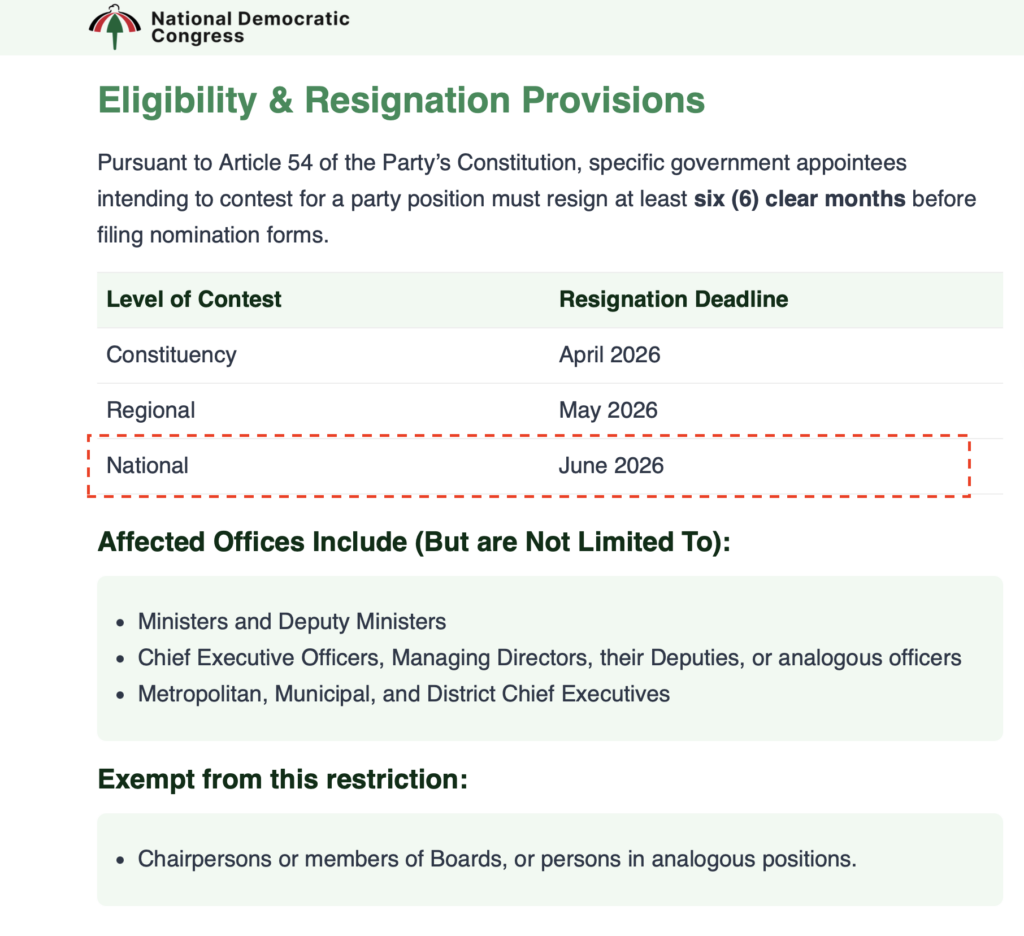
Based on the party’s six-month requirement, affected officeholders would have had to resign by June 2026 to remain eligible to file nominations.
July 19, 2026 marks exactly six months before the congress date.
Despite the deadline passing, none of the affected NDC national executives serving in government has publicly announced their resignation.
That either suggests they do not intend to seek re-election to their respective party positions or are relying on a change in the current rules.
Based on the current list of national executives who also hold government appointments, the following officials fall within the category of persons affected by the directive if they intended to seek re-election to party office:
| Party Executive | Government position |
| George Opare Addo | Minister for Youth Development and Empowerment |
| Sammy Gyamfi | CEO, Ghana Gold Board |
| Malik Basintale | CEO, Youth Employment Agency |
| Osman Ayariga | CEO, National Youth Authority |
| Hanna Bissiw | CEO, Minerals Development Fund |
| Ruth Seddoh | Director-General, National Service Authority |
| Elikem Kotoko | Deputy CEO, Forestry Commission |
| Abigail Elorm Mensah | CEO, MASLOC |
The implication is broader than the current list of national executives.
Under the directive, Ministers, Deputy Ministers, Chief Executive Officers, Managing Directors and their deputies, Metropolitan, Municipal and District Chief Executives, and persons in analogous offices who are currently in office are ineligible to contest for party office under the current rules.
However, the matter is not entirely settled.
On July 1, 2026, an NDC member filed a case at the High Court challenging the six-month resignation requirement announced by the party. The case remains pending, and its eventual outcome could affect the interpretation or enforcement of the directive.
Until a court rules otherwise, the party’s announced position remains that affected officeholders were required to resign at least six clear months before filing nominations.
In practical terms, that means government appointees who are currently in office have, under the current directive, effectively ruled themselves out of contesting for national party positions at the December 2026 congress.
It also suggests that at least 8 current national executives serving in government have decided not to seek re-election unless the court challenge alters the position.