
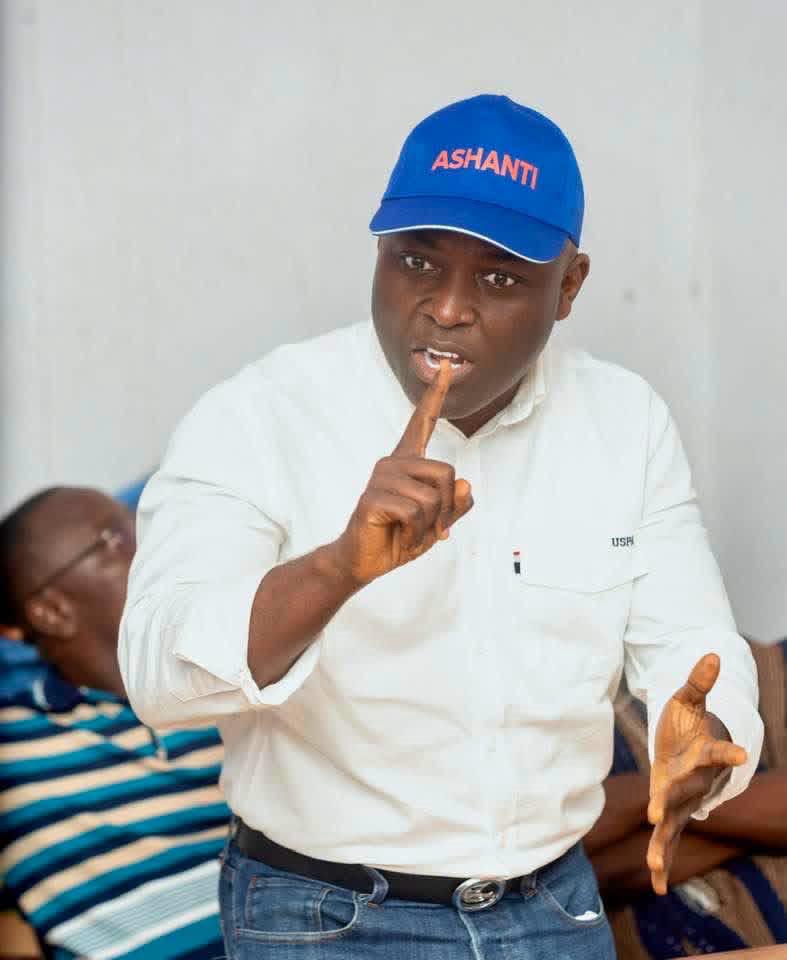
For the New Patriotic Party (NPP), the change at the top of its Ashanti Regional structure is more than a routine leadership transition.
It marks the end of the era of Bernard Antwi Boasiako, popularly known as Chairman Wontumi, and the beginning of a new chapter under Odeneho Kwaku Appiah, better known as COKA.
When COKA sailed through vetting to contest the Ashanti Regional chairmanship, he made his pitch in a phrase that appeared designed to distinguish his leadership style from the politics of personality and spectacle:
“I will lead Ashanti with less speeches and more work.”
Three weeks later, delegates handed him the mandate.
COKA secured 663 votes to defeat Dr Henry Kwabena Kokofu, a former head of Ghana’s Environmental Protection Authority (EPA) who polled 269 votes, in a contest widely watched for what it could mean for the NPP’s organisation and electoral fortunes in its most important stronghold.
For COKA, however, the victory was the culmination of a political journey that began far below the regional level.
A grassroots politician’s long journey
Unlike politicians who emerge primarily through national prominence, COKA’s political credentials have been built over decades within the NPP’s grassroots structures.
He has served as a Ward Organiser, Ward Chairman, Regional Financial Secretary and Constituency Chairman for Afigya Kwabre, a position he held for five terms.
He also chaired the Conference of Constituency Chairmen in Ashanti for two terms and served on several party committees.
That experience has given him an intimate understanding of the party’s machinery, from polling-station organisation to constituency administration and regional coordination.
His supporters have long portrayed him as a politician who is accessible, consultative and willing to work quietly behind the scenes.
That image became particularly pronounced during his years of grassroots engagement, when he continued to support party members, widows, and vulnerable people across the region even after losing the regional chairmanship contest in 2022.
It was this reputation for welfare and grassroots support that helped cement the nickname “Asanteman COKA, I Care.”
Education, business and a broader profile
COKA also brings an academic and professional profile that adds another dimension to his political identity.
He holds a degree in Business Administration and a Master of Arts in Peace, Security and Intelligence Management from the University of Professional Studies, Accra (UPSA). He has also worked across areas including governance, gender issues, youth development, general management and development.
His professional background extends into business. He has more than two decades of experience as a private-sector executive and has been involved in businesses spanning hospitality, construction, transportation and haulage.
He’s acknowledged as a businessman with experience in those sectors and as a director of Longford Royal Group Limited.
This combination of political experience, formal education and business exposure now forms part of the profile he takes into the Ashanti regional leadership.
From Wontumi’s era to a different political style
The comparison with his predecessor is almost inevitable. Chairman Wontumi was a larger-than-life political personality whose public style was markedly different from COKA’s.
While COKA has built his campaign around quiet mobilisation, consultation and the language of work, Wontumi has become known for a highly energetic, outspoken and often jovial public persona.
His speeches, distinctive delivery and willingness to engage political opponents directly made him one of the NPP’s most recognisable regional figures.
His supporters saw that personality as part of his political strength. Critics, however, sometimes interpreted the same style as overly flamboyant or lacking the seriousness expected of a regional party chairman.
Some critics also questioned whether Wontumi’s wealth and business influence gave him an advantage in party politics. Those perceptions became part of the broader debate about the kind of leadership the Ashanti NPP needed.
Wontumi himself has repeatedly defended his political record based on experience rather than formal qualifications, arguing that his years of service and grassroots work should matter more than certificates.
COKA presents a somewhat different proposition. His public persona is calmer. His campaign language has been less about personality and more about organisation, structure and measurable electoral results.
That does not necessarily make one style better than the other.
But it does suggest that the Ashanti NPP has chosen a different type of political communication at a time when the party is trying to recover from a difficult election.
The Wontumi chapter ends under extraordinary circumstances
The circumstances surrounding the change are also significant. Wontumi had served as Ashanti Regional Chairman for three terms and defeated COKA in the 2022 regional contest, polling 464 votes against COKA’s 306.
By 2026, Wontumi had set his sights on the NPP’s national chairmanship, formally declaring his intention to contest the position and campaigning across the country.
His regional tenure, however, came to an abrupt and dramatic interruption when an Accra High Court convicted him in July 2026 over illegal-mining-related offences connected to the Samreboi concession and sentenced him to 20 years’ imprisonment. The NPP has rejected the judgment and announced plans to appeal.
Whatever the outcome of that appeal, the development has fundamentally altered the political context in which the NPP’s Ashanti leadership transition is taking place.
A different face after a bruising election
The change comes against the backdrop of the NPP’s disappointing performance in the 2024 general election.
The party’s presidential candidate, Dr Mahamudu Bawumia, secured approximately 1.37 million votes in Ashanti, representing about 65 per cent, compared with about 1.79 million votes in 2020.
The NPP also lost 10 of the region’s 47 parliamentary seats to the National Democratic Congress (NDC).
Those losses have generated debate within the party about organisation, leadership, internal unity and the ability of the regional structure to reconnect with voters.
COKA’s answer is straightforward: rebuild the organisation.
His campaign has centred on creating a strong and united party with structures that work from the polling-station level to the regional office.
“I am coming to lead the Ashanti Region so we can do everything legally possible to increase our presidential votes, increase our parliamentary seats, and win Election 2028,” he said during his campaign.
He has also stressed collective leadership. “We will work together. We will decide together. We will enjoy together. And yes, we will even suffer together. But most importantly, we will protect and defend our party constitution.”
Can calm replace charisma?
This is perhaps the most interesting question surrounding the new chairman.
Wontumi’s political brand was built around visibility, energy, humour, wealth and an unmistakable public presence.
COKA’s brand is being built around experience, education, organisation and a quieter style of engagement.
That contrast may matter as the NPP attempts to repair its image.
For some party members and political observers, a more measured and professionally presented regional chairman could help project an image of seriousness and discipline after an election defeat and a turbulent period for the party.
Others may argue that Ashanti politics requires the kind of energy, mobilisation and forceful personality that made Wontumi effective with sections of the party’s grassroots.
The real test, therefore, will not be whether COKA is less loud than Wontumi.
It will be whether his quieter approach can produce louder electoral results.
The philanthropist and businessman
Beyond party politics, COKA’s reputation as a businessman and philanthropist is another important part of his public profile.
His supporters point to his involvement in hospitality and other businesses, as well as his financial and welfare support for party members and vulnerable people.
For years, that support has helped him maintain relationships with constituencies and grassroots activists across Ashanti.
But philanthropy alone cannot rebuild a political party.
As chairman, he will have to convert goodwill into organisation, organisation into mobilisation and mobilisation into votes.
That is a far more difficult task than supporting individuals or constituencies.
Less talk, more work — but now the work begins
COKA’s most repeated campaign promise was that he would lead with “less talk and more action”.
The delegates have now given him the opportunity to prove it.
His immediate challenges include rebuilding the party’s grassroots structures, managing internal divisions, reconnecting with members who became disengaged after the 2024 defeat and helping the NPP recover parliamentary seats lost to the NDC.
He must also increase the party’s presidential vote in a region that remains central to its hopes of returning to power in 2028.
That means the new chairman will ultimately be judged not by how different he looks or sounds from Wontumi, but by what his leadership delivers.
Wontumi’s era was defined by a highly visible and charismatic political personality.
COKA now has the opportunity to define his own era through structure, discipline, consultation and results.
Whether that calmer and more formally educated profile will translate into a stronger NPP in Ashanti remains to be seen.
But one thing is already clear.
The Ashanti NPP has entered a new political chapter.
And for COKA, the campaign is over.
The work has begun.